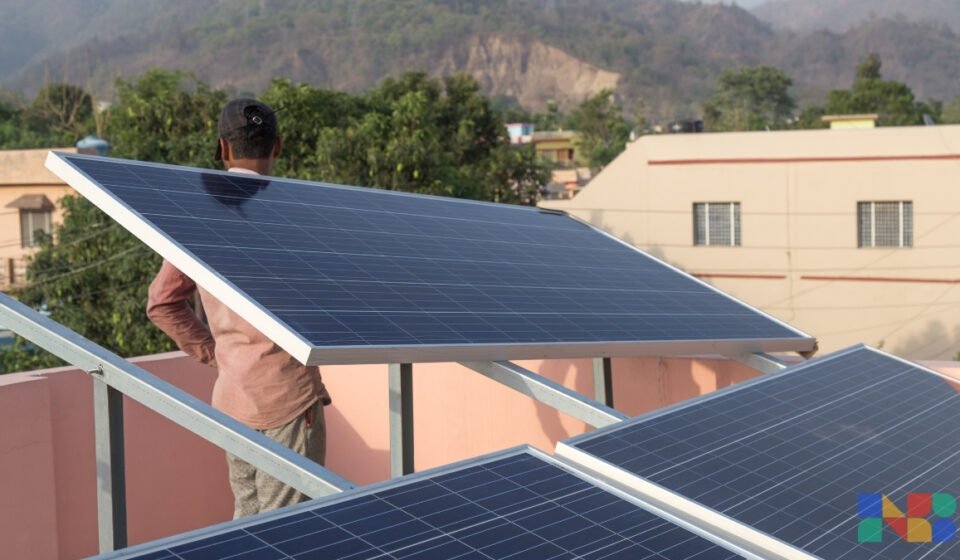
PM Surya Ghar is Changing How Rural India Can Lead the Clean Energy Movement!

India’s Solar Energy Story at a Glance:
- India’s solar energy growth is expanding from cities to rural Bharat.
- PM Surya Ghar Muft Bijli Yojana aims to install rooftop solar on one crore households.
- Households can receive subsidies and earn income by selling surplus electricity.
- One Model Solar Village is planned in every district of India.
- Rural households can become “prosumers” by producing and selling electricity.
- Solar schemes such as PM-KUSUM and PM JANMAN are supporting farmers and remote habitations.
- Financing, vendor capacity and net-metering approvals remain key challenges.
- Rural India could play a major role in achieving India’s 500 GW clean energy target.
India’s solar story is no longer just about big city rooftops and coastal wind farms. The real revolution is happening in the fields, forests, and hamlets of rural Bharat — and the numbers prove it.
India crossed a historic milestone in July 2025: 119.02 GW of total solar energy capacity, according to the Ministry of New and Renewable Energy (MNRE). That is a staggering 30-fold increase in just nine years. India now ranks third globally in solar power production. But the more interesting question is not how much solar India has — it is where that solar is going next. And the answer, increasingly, is the village.
The Scheme That Changed Everything
On February 13, 2024, Prime Minister Narendra Modi launched the Pradhan Mantri Surya Ghar: Muft Bijli Yojana — described at its launch as the world’s largest domestic rooftop solar initiative. The scale of ambition was breathtaking: install rooftop solar panels on one crore (10 million) Indian households by FY2026-27, with a financial outlay of ₹75,021 crore (approximately US$9 billion).
The scheme offers subsidies of up to 40% for installation, covering up to ₹78,000 for a 3 kW residential system. Households can earn up to ₹17,000-18,000 per year by selling surplus electricity back to the grid. That is not a utility subsidy — that is a household income source.
The Model Solar Village: Every District Gets One
Perhaps the most revolutionary part of PM Surya Ghar is a clause that barely made headlines: a Model Solar Village will be developed in every district of India. Each of these villages will serve as a living demonstration of what rooftop solar adoption looks like — showing farmers, homemakers, and small traders exactly what clean energy can do for a household budget.
The logic is simple and powerful. People in rural India trust what they can see. When the family in the next village has stopped paying electricity bills — and is earning extra income from selling solar power — the adoption barrier collapses faster than any government advertisement can achieve.
This model-village approach mirrors successful rural sanitation and water campaigns from earlier decades. It creates peer-to-peer influence, which research shows is the most effective driver of behaviour change in rural communities.
Also Read: Model Village Scheme Mission
Rural India as Energy Producer: The Real Opportunity
Here is the idea that most policy discussions still understate: rural India is not just an energy consumer — it is potentially the world’s largest distributed energy producer.
India has a technical rooftop solar potential of nearly 796 GW, the vast majority of which is untapped. Villages with abundant sunlight, open land, and lower electricity consumption relative to generation potential could become net energy exporters — feeding power back into the grid for industrial and urban users to consume.
This concept, sometimes called prosumer villages, is already playing out in isolated pockets across Gujarat, Maharashtra and Tamil Nadu. A farmer with a 3 kW solar system generates more electricity than his household uses during the day. The surplus goes into the grid. At the end of the month, instead of a bill, he receives a payment. His electricity — produced on his own rooftop — is now a commodity he sells.
| Schemes | Target | Benefit for Rural India | Status |
| PM Surya Ghar: Muft Bijli Yojana | 1 crore households by FY27 | 300 units free/month + ₹18K/yr income |
23 lakh+ covered (Dec 2025)
|
| Model Solar Village (per district) | 1 per district, all India | Peer-to-peer adoption model |
Rollout ongoing
|
| MNRE Tribal Solar (PM JANMAN) | PVTG habitations, off-grid | Home lighting + mini-grids |
4,919 HH electrified (Nov 2025)
|
| PM Kusum Scheme | Solar pumps for farmers | Reduced irrigation costs |
Expanding across agrarian states
|
The Challenges Are Real — And They Are Solvable
The picture is not entirely rosy. As the Institute for Energy Economics and Financial Analysis (IEEFA) noted in its December 2025 report, only 22.7% of applications under PM Surya Ghar have translated into completed installations. As of July 2025, just 13.1% of the target of 1 crore installations had been achieved, despite nearly 57.9 lakh applications. The conversion gap points to three structural hurdles: financing complexity, vendor capacity, and net-metering approvals.
In rural areas, these bottlenecks are sharper. Rural households have limited access to collateral-free solar loans. Local installers are few and often untrained. And DISCOMs (electricity distribution companies) in many states have been slow to approve net meters — the very mechanism that makes selling surplus power possible.
The IEEFA report recommends state-level targets with clear timelines, simplified financing, and stronger grievance mechanisms. These are not impossible fixes. They are administrative problems with administrative solutions — and India has demonstrated, many times over, that it can execute at scale when political will aligns with bureaucratic clarity.
Why the Village Is the Right Bet
India’s cities are already undergoing solar adoption. But cities face acute space constraints — high-rises and dense housing colonies leave little room for large-scale rooftop installations. Villages, by contrast, have space, sunlight, and a genuine economic incentive to adopt. Electricity bills are a burden in rural households. The savings — and potential earnings — from rooftop solar are proportionally more impactful for a village family than for an urban apartment dweller.
Then there is the climate angle. India has committed to achieving 500 GW of non-fossil fuel capacity by 2030, with rooftop solar expected to contribute around 100 GW of that total. You cannot hit 100 GW of rooftop solar by focusing only on cities. Rural Bharat has to be part of the story — and increasingly, it is.
For breaking Green Energy News and Green Energy News in India, including solar, wind, EV, and clean energy updates, stay connected with Bharat360 News4Bharat.
Frequently Asked Questions