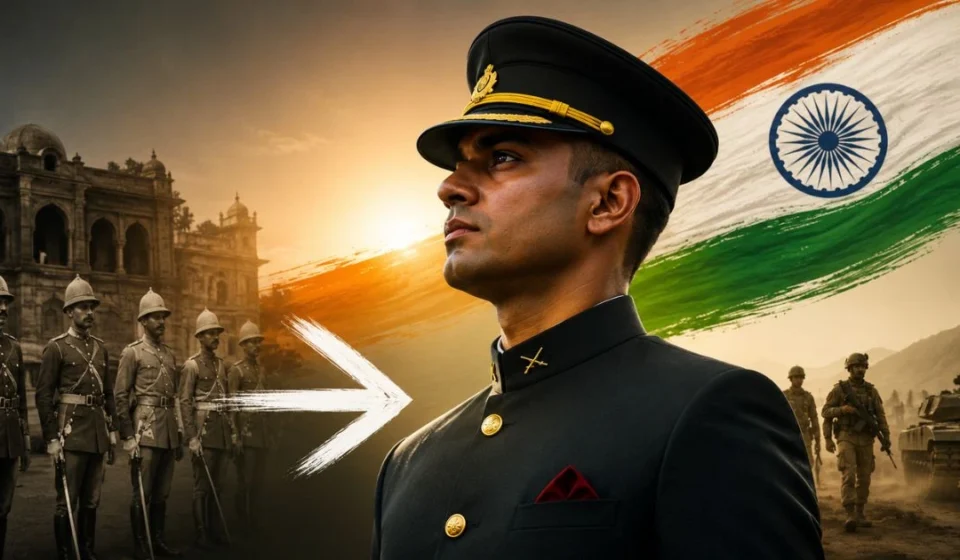

The Indian Army has introduced one of its most significant dress regulation updates in nearly eight years with the release of the new Army Uniforms-2026 manual. The revised rules remove several residual colonial-era customs, including the mandatory carriage of swords by Reviewing Officers, the use of pouch belts with select mess dresses, and archaic terminology such as “Royal.” At the same time, the Army has authorised more indigenous and practical options, including the closed-neck Bandi jacket as part of civil formal attire.
The move is being seen as more than a uniform update. It marks a wider effort to align military traditions with India’s contemporary national identity while preserving the dignity, discipline and ceremonial character of the force.
What Has Changed In The New Army Dress Code?
The new dress regulations focus on removing non-essential colonial-era symbols while maintaining the dignity and traditions of the Indian Army.
Key changes include:
1. Sword carriage is no longer mandatory for Reviewing Officers
Reviewing Officers will no longer be required to carry swords during parades. However, swords have not been banned. They will continue to be used by parade commanders, contingent commanders and designated ceremonial personnel on specific occasions.
2. Pouch belts removed from Mess Dress Nos. 5 and 6
The Army has removed pouch belts from certain mess dress categories. These belts were seen as part of inherited colonial-era dress practices.
3. The word “Royal” dropped from official usage
Archaic British-era terminology such as “Royal” has been discontinued from official dress-related references.
4. Bandi jacket introduced as formal civil attire
One of the most visible additions is the closed-neck Bandi jacket, an indigenous Indian-style garment. It has been authorised as part of civil formal dress and can be worn with a full-sleeved shirt, matching formal trousers and closed footwear.
5. New rules on tattoos and grooming
The updated manual also includes clearer rules on tattoos, piercings, grooming and personal appearance to ensure uniformity and discipline across the force.
6. Battle Jacket introduced for winter working dress
Another important update is the introduction of a new Battle Jacket as part of winter working dress. Reports suggest that it will gradually replace the older jersey-based winter uniform, with the transition expected to continue until June 2029.
Also Read: Indian Army to Buy 300 More K9 Vajra Artillery Guns, Worth?
A New Indigenous Jacket Joins The Indian Army
The introduction of the Bandi jacket is one of the most symbolic parts of the new dress code. Earlier, officers had limited options for formal civil attire, including the bandhgala, lounge suit, or full-sleeve shirt with tie. The addition of the Bandi jacket gives officers a distinctly Indian formal option.
This is not just a fashion change. It reflects a conscious effort to bring Indian cultural identity into official military dress while retaining the discipline and formality expected in the armed forces.
Straight From The Source: Why This Matters?
The Army has explained its reasoning clearly. Officials describe this as a thoughtful, careful process.
The manual states that these refinements represent a progressive review of residual colonial-era vestiges while preserving the dignity, functionality and enduring traditions of the Indian Army.
This single line sums up the entire goal. The Army wants change, but it does not want to lose its core traditions.
Also Read: Planetary Defence: Why Every Young Mind Needs to Join This Mission?
Rewind: How This Movement Began
This is not a sudden decision. It has a long history.
- In 2021, PM Modi asked the armed forces to drop colonial habits.
- The Indian Navy started this change first, around 2022.
- The Indian Navy later allowed its officers to wear kurta-pyjama in messes.
- The Navy also stopped officers from using batons.
This shows a steady pattern. Since 2022, the Indian Navy has led the effort among the three Armed Forces to remove colonial-era practices and symbols, following Prime Minister Narendra Modi’s vision.
Also Read: Made in India Airbus C295: India’s Historic Leap in Defence Manufacturing
The Latest Chapter In This Ongoing Reform
Now, the Army has joined this movement too. The new changes are detailed. They cover many areas.
This indigenisation drive is part of a bigger plan. The goal is simple. India’s military should show India’s own identity. It should not follow borrowed customs.
Looking Ahead: More Changes Coming?
Officials have described these changes as a major reform. According to reports, the new rules aim to combine modern ideas with respect for military traditions.
More changes could be introduced in the future. The Army may also review other ceremonial practices. These updates show that the Army is willing to adapt and make improvements while preserving its core values.
Frequently Asked Questions
1) What is the Indian Army’s new dress code about?
Ans. It removes several British-era customs. These changes are listed in the new Army Uniforms-2026 Pamphlet.
2) What is the Army Uniforms-2026 Pamphlet?
Ans. It is the Army’s official manual. It lists all the new dress and grooming rules.
3) Is sword carriage still compulsory for Reviewing Officers?
Ans. No. Sword carriage by Reviewing Officers is now optional, not compulsory.
4) What is the Bandi jacket?
Ans. It is a new, indigenous jacket for officers & has a closed-neck design. It is now part of formal civil attire.
5) Why has the term “Royal” been removed?
Ans. The term comes from British rule. The Army removed it to drop colonial-era language.