
Key Takeaways:
- NIBE Limited has confirmed that the Vayu Astra-1 loitering munition can be launched directly from the Suryastra long-range rocket system.
- The integration creates a dual-purpose deep-strike platform, allowing commanders to switch between rockets and kamikaze drones from a single vehicle.
- Trials were held at Pokhran (desert) and Joshimath (high altitude) on a no-cost, no-commitment basis for the Indian Army.
- The drone achieved a CEP of under one metre at 100 km range, carried a 10 kg warhead, and flew for over 90 minutes above 14,000 feet.
- The Vayu Astra-1 features a recoverable architecture — it can be retrieved and reused in training or aborted missions.
- The Suryastra is India’s first indigenous multi-calibre rocket launcher, developed with Israel’s Elbit Systems.
- The Indian Army signed a ₹293-crore emergency procurement for Suryastra, which was officially inducted by Defence Minister Rajnath Singh in May 2026.
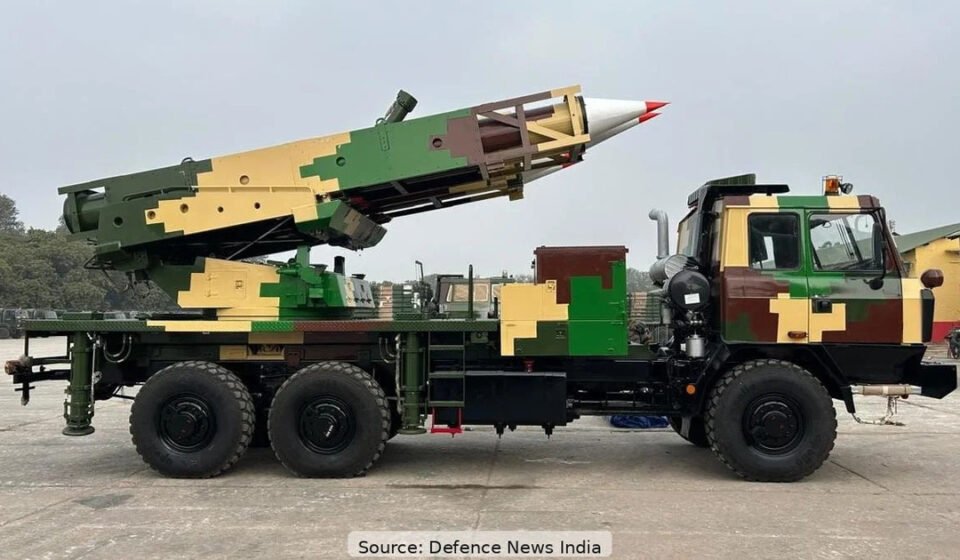
- The system is mounted on a BEML Tatra 6×6 truck for high mobility and shoot-and-scoot battlefield tactics.
India’s homegrown defence industry has quietly crossed a landmark threshold. Pune-based NIBE Limited has confirmed that its Vayu Astra-1 loitering munition can launch directly from the Suryastra rocket system. Together, these two indigenous weapons form a deep-strike combination that defence analysts are calling a genuine force multiplier for the Indian Army.
However, what makes this announcement truly significant is not just the technology. It is the timing. India’s battlefield doctrines are shifting rapidly, and this integration arrives at precisely the right moment.
Also Read| India Launches Three Warships at Once — PM Modi’s Biggest Naval Statement Yet
A Single Platform. Two Lethal Options.
Until now, artillery commanders had to choose between long-range rocket fire and drone-based precision strikes. Those were two separate assets, two separate logistics chains, and two separate decisions. With the Vayu Astra-1 now firing from the Suryastra launcher, that choice collapses into one vehicle.
Commanders on the front line can therefore switch seamlessly between a conventional guided rocket barrage and a kamikaze drone strike. Furthermore, they can make that switch based on live battlefield data, without repositioning or calling for additional assets. In short, the Suryastra-Vayu Astra combination gives India’s artillery units a sharper, faster, and far more adaptable edge.
Also Read| Something Big Is Rolling Out of Bengaluru in 2027 — And It Runs at 280 kmph
Tested in the Harshest Conditions India Has to Offer
NIBE did not test the Vayu Astra-1 in controlled laboratory conditions. Instead, the company took it to the extremes. In April 2026, the drone underwent technical trials across two vastly different environments the scorching desert range at Pokhran, Rajasthan, and the freezing high-altitude terrain of Joshimath, Uttarakhand.
Both locations were deliberately chosen to reflect real Indian operational theatres. The results, moreover, left little room for doubt. Carrying a 10 kg warhead, the Vayu Astra-1 struck targets at 100 kilometres with a Circular Error Probable of under one metre. Additionally, it demonstrated night-strike capabilities and sustained high-altitude endurance of over 90 minutes above 14,000 feet. For a domestically built loitering munition, these are remarkable numbers.
Not Just a Drone. A Recoverable Asset.
Most loitering munitions around the world are one-time weapons. They dive, they detonate, and they are gone. The Vayu Astra-1 breaks that mould. Its recoverable architecture allows operators to abort a mission mid-flight and bring the drone back safely. Consequently, the system doubles as a training asset, reducing costs significantly over time.
In combat, the Vayu Astra-1 targets radar installations, mobile air defence units, command centres, and enemy artillery positions. These are precisely the targets that degrade an adversary’s ability to respond. Destroying them early in a conflict can, therefore, decisively shape how a battle unfolds.
The Suryastra: India’s Versatile Artillery Backbone
To understand why this integration matters, one must first understand the Suryastra itself. It is India’s first locally manufactured universal multi-calibre rocket launcher, developed by NIBE in partnership with Israel’s Elbit Systems. Specifically, it draws on the proven Precise and Universal Launching System, widely known as PULS.
Also Read| India Built Its First Hovercraft in Under a Year — Here’s What That Really Means
What sets the Suryastra apart is its modular pod design. A single launch vehicle can carry 122 mm, 160 mm, and 306 mm rockets, as well as tactical missiles, without any structural changes to the platform. As a result, field commanders can adapt their firepower to the mission without waiting for specialised vehicles. This also dramatically simplifies supply chains in forward areas.
The system’s range further underlines its strategic value. Built to engage targets at 150 kilometres and 300 kilometres, it relies on a combination of inertial and GPS navigation. Reports indicate it maintains an error margin of under three to five metres at those distances — a level of precision that rivals far more expensive Western systems.
From Emergency Procurement to Official Induction
The Indian Army moved quickly once it recognised the Suryastra’s potential. It signed a ₹293-crore emergency procurement contract for the system’s immediate induction. Subsequently, Defence Minister Rajnath Singh officially introduced the Suryastra to the armed forces in May 2026, following successful field tests at the Integrated Test Range in Chandipur, Odisha.
The emergency procurement route is significant. India reserves it for capabilities it considers urgently needed. Choosing this path for the Suryastra signals that the Army sees it not as a future asset, but as an immediate operational priority.
A Lesson Drawn from Ukraine
The integration of loitering munitions into rocket artillery is not an idea born in isolation. Conflicts in Ukraine demonstrated conclusively that loitering drones change the rhythm of warfare. Unlike a rocket, a drone can loiter over a target zone, assess threats in real time, and strike when conditions are optimal. Moreover, it can be recalled if the target moves or if the tactical situation changes.
Also Read| BPSSC SI Prohibition Pre Admit Card 2026 Out; Check How to Download
NIBE’s approach mirrors the capability philosophy behind Elbit’s SkyStriker system. Indeed, the Vayu Astra-1 brings that same class of autonomous strike logic to an Indian-built platform. Consequently, Indian commanders will be able to call in precise drone strikes and heavy rocket barrages from the same vehicle, depending on what the battlefield demands.
Survivability by Design
All this firepower would count for little if the platform itself were vulnerable. NIBE has addressed this directly. The Suryastra rides on a rugged BEML Tatra 6×6 high-mobility truck, built to operate across mountains, deserts, and border terrain alike.
More importantly, the system employs shoot-and-scoot tactics fire a salvo and immediately relocate before the enemy can calculate a counter-battery response. This approach keeps the launcher alive and ready to engage again. Furthermore, it forces adversaries to respond to a threat that is never where they expect it to be.