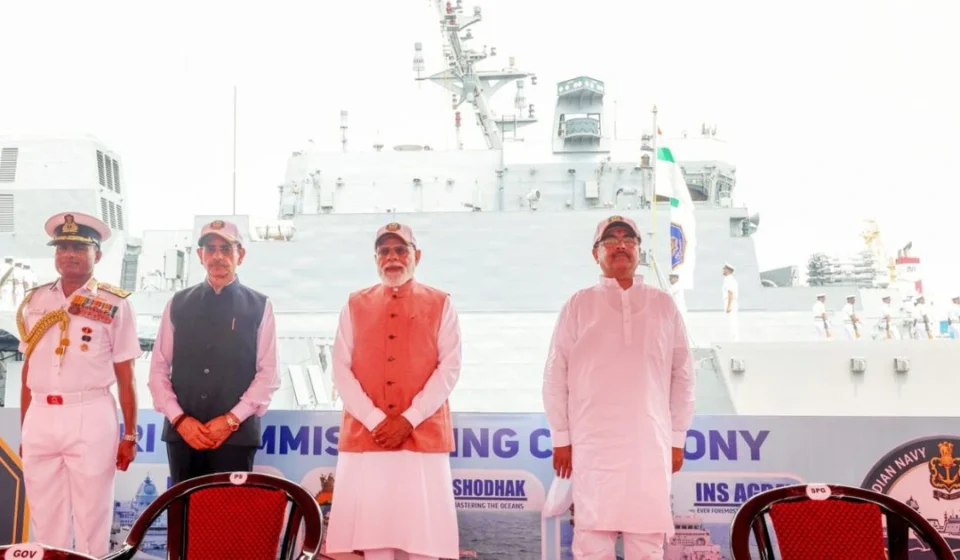

Prime Minister Narendra Modi commissioned three advanced naval vessels — INS Dunagiri, INS Sanshodhak and INS Agray — into the Indian Navy on June 21, 2026, at the Garden Reach Shipbuilders and Engineers (GRSE) shipyard in Kolkata.
The Indian Navy’s commissioning of these vessels strengthens India’s naval power and sends a strong signal of the country’s growing defence capabilities.
What Makes Each Vessel Special?
The Indian Navy designed these three vessels for different roles and specific missions.
1) INS Dunagiri– A modern stealth frigate equipped with BrahMos missiles, an air-defence missile system, and a 76 mm naval gun. Its stealth features help it avoid detection during long-range operations.
2) INS Sanshodhak– A survey vessel used for hydrographic mapping and maritime research. It can also assist in disaster relief, humanitarian missions, and search-and-rescue operations.
3) INS Agray – An anti-submarine warfare vessel built to detect and counter underwater threats in shallow coastal waters. It is equipped with sonar systems, torpedoes, and indigenous rocket launchers.
Together, these three vessels strengthen the Indian Navy’s capabilities across combat, surveillance, and coastal defence operations.
Also Read: India Built Its First Hovercraft in Under a Year — Here’s What That Really Means
The Number That Changes Everything
While most reports are focusing on the ships themselves, another important story lies behind their construction.
More than 200 MSMEs contributed to the project, manufacturing over 75% of the components used in all three vessels in India.
India’s domestic defence production also reached a record ₹1.78 lakh crore in 2025–26, marking a 15.6% increase compared to the previous year.
These developments highlight not just the growth of India’s shipbuilding sector, but also the rapid expansion of the country’s defence manufacturing ecosystem.
Also Read: Nibe Demonstrates Garudastra 120mm Mounted Mortar System to Indian Army at Mhow
What PM Modi Said?
Speaking at the commissioning ceremony, Prime Minister Narendra Modi said India designed and built the three vessels, showcasing the country’s growing strength in defence manufacturing.
He also emphasized that India is moving beyond being just a defence buyer and is becoming a major producer of military equipment. Modi noted that more than 40 indigenous warships and submarines have joined the armed forces in recent years, with several more currently under construction.
The expansion reflects India’s growing focus on strengthening its naval capabilities and defence self-reliance.
Why This Matters Beyond Defence
Defence Minister Rajnath Singh called the commissioning of the three vessels a major milestone for India’s defence manufacturing sector and said that the country sourced more than 75% of their components from within.
The Indian Navy aims to expand its fleet to around 200 ships by 2035 and plans to build all future vessels in India.
The induction of these ships marks another step in India’s efforts to strengthen its naval power and boost self-reliance in defence production.
Frequently Asked Questions
Q1. Which three vessels did India commission on June 21, 2026?
Ans. India commissioned INS Dunagiri, INS Sanshodhak, and INS Agray at the GRSE shipyard in Kolkata. PM Modi presided over the ceremony.
Q2. What is INS Dunagiri and what can it do?
Ans. INS Dunagiri is a Project 17A stealth frigate. It carries BrahMos supersonic missiles, anti-submarine equipment, and radar-absorbing hull design. It is built for long-duration multi-domain combat missions.
Q3. What is INS Agray used for?
Ans. INS Agray is an anti-submarine warfare shallow water craft. It detects and neutralises underwater threats in coastal waters using sonar systems, torpedoes, and indigenous rocket launchers.
Q4. How much of these ships is Made in India?
Ans. Indian manufacturers sourced more than 75 percent of the equipment and systems installed on all three vessels from within the country. More than 200 MSMEs across India participated in their construction.
Q5. Where were these three indigenous vessels built?
Ans. The Indian Navy’s Warship Design Bureau designed all three vessels, and Garden Reach Shipbuilders and Engineers (GRSE) in Kolkata built them entirely in India.