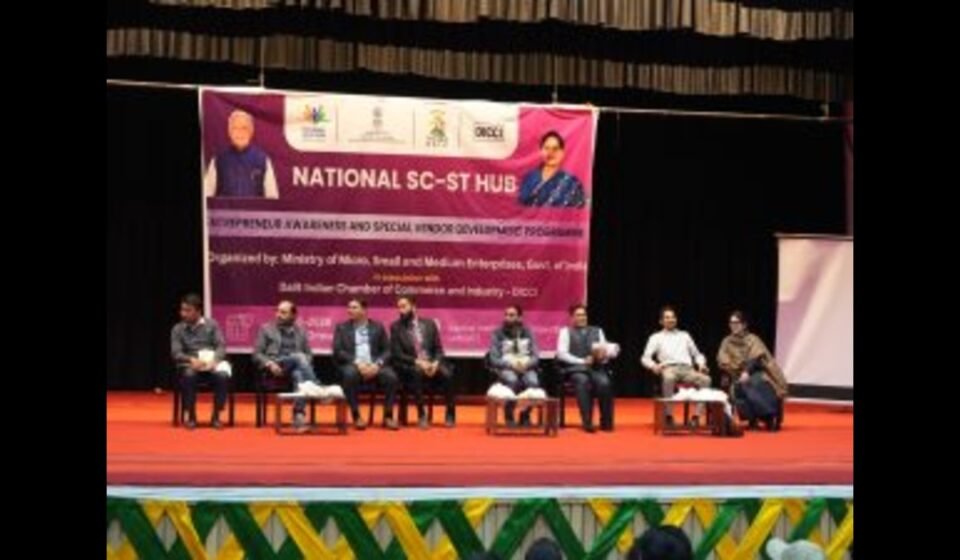

The National SC-ST Hub (NSSH), operating under the Ministry of Micro, Small and Medium Enterprises (MSME), organised an Entrepreneur Awareness and Special Vendor Development Programme (EA&SVDP) in Leh on June 5, 2026.
The event took place at the Central Institute of Buddhist Studies, Leh, in collaboration with the Dalit Indian Chamber of Commerce and Industry (DICCI). More than 100 existing and aspiring entrepreneurs attended the programme, making it one of the region’s key entrepreneurship-focused events.
Importantly, the initiative aimed to create awareness about government schemes, procurement opportunities, and business support available to Scheduled Caste (SC) and Scheduled Tribe (ST) entrepreneurs.
Also Read| Gujarat Cluster Development Scheme: Eligibility, Benefits, How to Apply for Artisan Support!
Why Was the Programme Organised?
The Ministry of MSME launched the programme to strengthen entrepreneurship among SC-ST communities and improve their participation in government procurement.
In particular, officials focused on the National SC-ST Hub Scheme, which supports SC-ST-owned Micro and Small Enterprises (MSEs) through capacity-building, market access, and financial assistance.
Furthermore, the programme encouraged Central Ministries, Departments, and Central Public Sector Enterprises (CPSEs) to achieve the government’s procurement target of purchasing at least 4% of goods and services from SC/ST-owned MSEs.
As a result, entrepreneurs gained a clearer understanding of how they can participate in government supply chains and expand their businesses.
Also Read| India and South Africa Strengthen MSME Ties — A New Chapter for Small Businesses
Entrepreneurs Learn About MSME Schemes
During the programme, experts explained several MSME schemes and support initiatives designed to help entrepreneurs start, manage, and grow their businesses.
For aspiring entrepreneurs, the sessions covered:
- Udyam Registration
- Enterprise formalisation
- Government support programmes
- Business development opportunities
- Entrepreneurship awareness
Meanwhile, existing entrepreneurs received guidance on:
- Vendor registration procedures
- Documentation requirements
- Government procurement opportunities
- E-tendering systems
- Credit facilitation schemes
- Subsidy benefits
- Business expansion strategies
In addition, experts shared practical insights on accessing government contracts and improving business competitiveness.
Also Read| Union Budget 2026 MSME Growth: Big Boost for Small Businesses in India
Direct Interaction with Government Agencies and Banks
One of the key highlights of the programme was the direct interaction between entrepreneurs and representatives from government departments, banks, and public sector enterprises.
This interaction allowed participants to ask questions, clarify doubts, and learn about real-world business opportunities.
Moreover, officials explained procurement processes, vendor registration requirements, and available financial assistance programmes.
As a result, entrepreneurs received valuable guidance that could help them secure contracts and grow their enterprises.
Key Organisations That Participated
Several prominent organisations participated in the programme and provided expert guidance to attendees.
Representatives attended from:
- Government e-Marketplace (GeM)
- Hindustan Petroleum Corporation Limited (HPCL)
- Power Grid Corporation of India
- Food Corporation of India (FCI)
- State Bank of India (SBI)
- Bank of India
- MSME Development and Facilitation Office (DFO), Jammu
- Directorate of Industries and Commerce, Ladakh
- Social and Tribal Welfare Department
- Industrial Training Institute (ITI), Leh
Because of the diverse representation, participants received information on procurement opportunities, financing options, government schemes, and market access.
Focus on Government Procurement Policy
Speaking during the programme, Surya Bhushan, Branch In-Charge of the National SC-ST Hub, Ludhiana, highlighted the importance of the Government of India’s Public Procurement Policy.
He explained that the policy requires Central Ministries, Departments, and CPSEs to procure:
- At least 4% from SC/ST-owned Micro and Small Enterprises
- At least 3% from women-owned Micro and Small Enterprises
Therefore, the policy creates significant business opportunities for entrepreneurs from underrepresented communities.
Furthermore, it helps promote inclusive economic growth and encourages greater participation in public procurement.
Technical Sessions Provide Practical Guidance
The programme also featured technical sessions led by experts from government agencies, financial institutions, and public sector enterprises.
During these sessions, participants learned about:
- Financial support mechanisms
- Vendor empanelment procedures
- Government procurement systems
- Credit and subsidy schemes
- E-tender participation
- Market linkage opportunities
Additionally, experts shared practical tips on improving business readiness and increasing chances of securing government contracts.
These sessions proved especially useful for entrepreneurs seeking to expand beyond local markets.
Strengthening Entrepreneurship in Ladakh
The Entrepreneur Awareness and Special Vendor Development Programme forms part of the Ministry of MSME’s broader mission to strengthen entrepreneurship across the country.
By connecting entrepreneurs with government agencies, banks, and CPSEs, the initiative helps create a supportive ecosystem for business growth. Moreover, such programmes encourage formalisation, improve market access, and enhance awareness of available support mechanisms.
Consequently, entrepreneurs gain better opportunities to build sustainable enterprises and generate employment within their communities.
Conclusion
The Entrepreneur Awareness and Special Vendor Development Programme in Leh provided a valuable platform for learning, networking, and business development.
Through expert sessions, direct stakeholder interactions, and awareness campaigns, participants gained practical knowledge about government schemes, procurement opportunities, and financial assistance programmes.
Most importantly, the initiative reinforced the government’s commitment to empowering SC-ST entrepreneurs and promoting inclusive economic growth.
As entrepreneurship continues to expand in Ladakh, programmes like these will play a crucial role in creating new opportunities, strengthening MSMEs, and supporting long-term regional development.