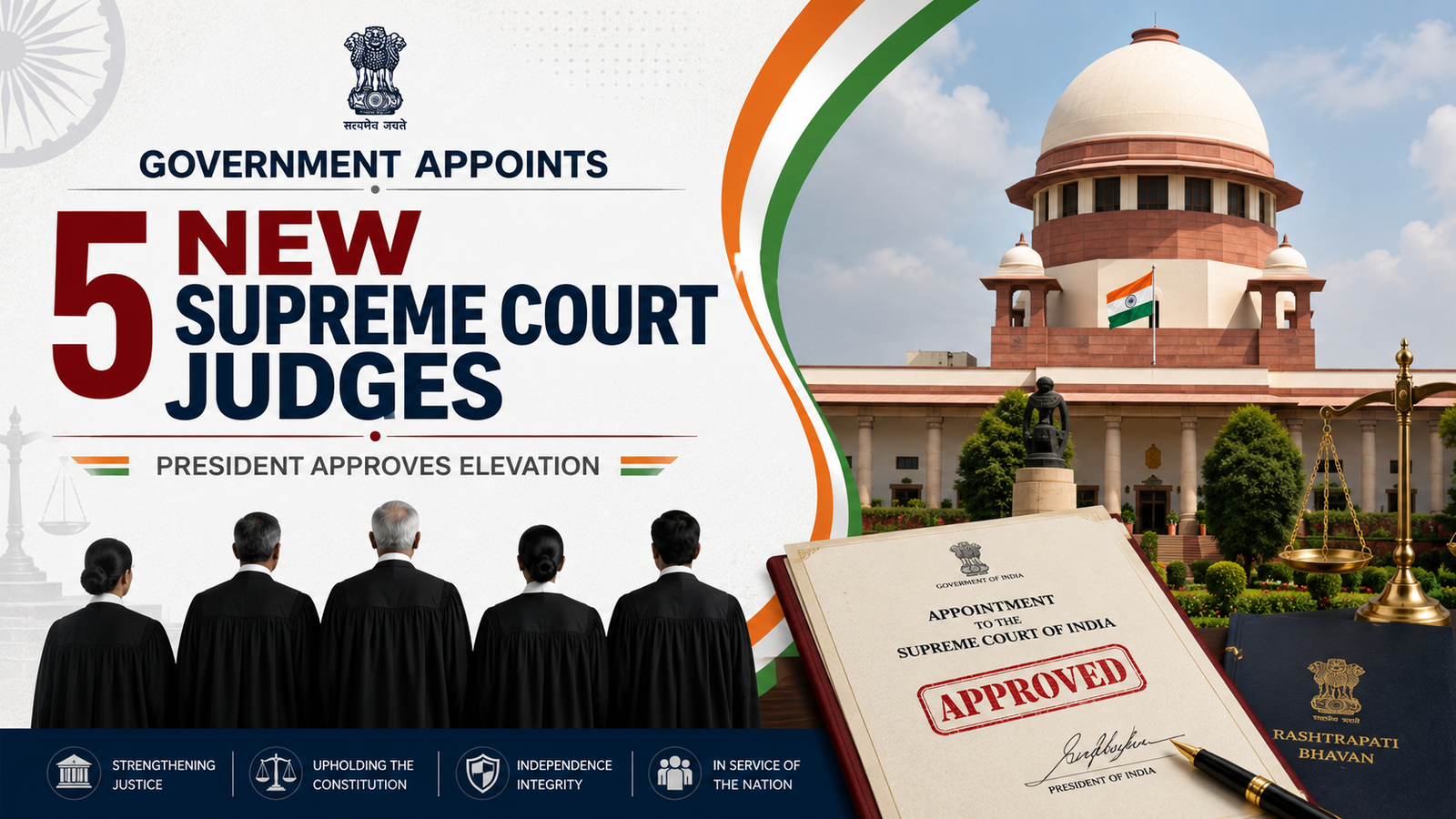
Government Appoints 5 New Supreme Court Judges; President Approves Elevation

The Supreme Court of India has received five new judges after the Central Government cleared the appointments recommended by the Supreme Court Collegium. President Droupadi Murmu has approved the elevation of four High Court Chief Justices and one senior advocate as judges of the apex court.
The Ministry of Law and Justice has issued the official notification under Article 124(2) of the Constitution of India. With these appointments, the working strength of the Supreme Court will rise to 37 judges, against the newly increased sanctioned strength of 38 judges, including the Chief Justice of India.
Who are the Newly Appointed Supreme Court Judges?
The newly appointed judges are:
- Justice Sheel Nagu – Chief Justice, Punjab and Haryana High Court
- Justice Shree Chandrashekhar – Chief Justice, Bombay High Court
- Justice Sanjeev Sachdeva – Chief Justice, Madhya Pradesh High Court
- Justice Arun Palli – Chief Justice, High Court of Jammu & Kashmir and Ladakh
- Senior Advocate V. Mohana – Supreme Court Senior Advocate
Why V. Mohana’s Appointment Is Significant?
Senior Advocate V. Mohana’s elevation is among the most notable appointments in this list. She has been appointed directly from the Bar, making her one of the few advocates to be elevated as a judge of the Supreme Court.
Her appointment is also important from the perspective of women’s representation in the higher judiciary. V. Mohana has had a long legal career before the Supreme Court and was designated as a Senior Advocate in 2015. She has appeared in several important constitutional and public interest matters, including cases related to women officers and permanent commission in the armed forces.
Also Read: Delhi High Court’s Key Judgement on 29th May 2026
Collegium Recommended the Names on May 27
The Supreme Court Collegium had recommended these five names on May 27, 2026. The Collegium was headed by Chief Justice of India Justice Surya Kant.
This is being seen as one of the first major judicial appointment recommendations made after Justice Surya Kant assumed office as the Chief Justice of India.
Supreme Court Moves Closer to Full Strength
The appointments come at a time when the Supreme Court is dealing with a heavy pendency of cases. The recent increase in the sanctioned strength of Supreme Court judges from 34 to 38, including the Chief Justice of India, was aimed at strengthening the judicial capacity of the country’s top court.
With the addition of five new judges, the Supreme Court will now function with 37 judges. This is expected to help in the formation of more benches and faster hearing of constitutional, civil, criminal and public interest matters.
Constitutional Process of Appointment
Supreme Court judges are appointed by the President of India under Article 124(2) of the Constitution. The process begins with the Supreme Court Collegium recommending suitable names. The Central Government then examines the recommendations and forwards them for presidential approval. Once approved, the Law Ministry issues the appointment notification.
Why This Development Matters
The appointment of five new judges is a major step toward improving the functioning of the Supreme Court. India’s top court has been facing a rising number of pending cases, and increasing judicial strength is seen as a necessary measure to ensure timely justice.
These appointments are also important because they reflect a mix of experience from High Court leadership and the Supreme Court Bar. The elevation of Senior Advocate V. Mohana further strengthens representation from the legal profession and adds to women’s presence in the higher judiciary.
Also Read: BIS Recruitment 2026
News4Bharat POV
The appointment of five new Supreme Court judges is a significant move to strengthen India’s judicial system. As the country’s highest court moves closer to its full sanctioned strength, the decision is expected to support faster case disposal and improve access to justice for citizens.
The elevation of V. Mohana is especially notable as it highlights the importance of both Bar representation and gender diversity in the judiciary.