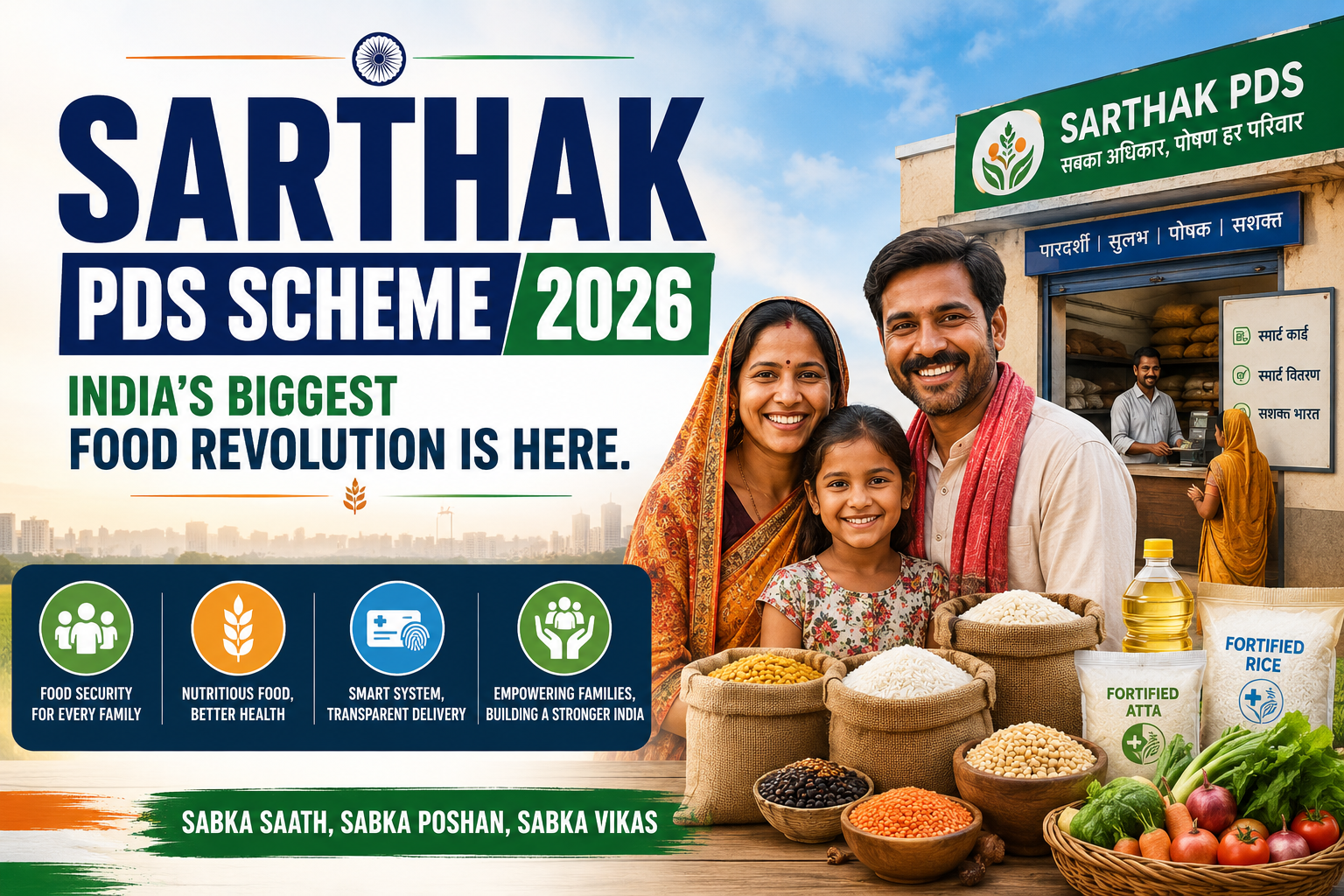

India feeds more than 80 crore people every month. That is one of the biggest food programmes in the world. But the system has always had problems. Leakages, delays, and corruption have hurt millions of families.
Now the government wants to fix all of this.
The Union Cabinet approved the SARTHAK PDS Scheme on 27 May 2026. It is a bold plan to use AI and technology to fix India’s ration system. Let us break it all down in simple words.
Quick Facts – Key Numbers First
| Detail | Data |
| Total Budget | ₹25,530 crore |
|
Scheme Duration
|
April 01, 2026 – March 31, 2031
|
|
Beneficiaries Covered
|
Approx. ₹80 Crore
|
|
States & UTs Covered
|
All 36 |
|
Annual Logistics Savings
|
Approx. ₹280 Crore
|
|
Carbon Emission Reduction
|
35% |
SARTHAK PDS Scheme 2026 — Complete Guide
SARTHAK: Scheme for Assistance in Ration Transport and Handling-Income with Automation in PDS.
It is an umbrella scheme aimed at strengthening India’s Public Distribution System (PDS) under the National Food Security Act (NFSA), 2013.
The Cabinet Committee on Economic Affairs (CCEA), chaired by Prime Minister Narendra Modi, approved the continuation and integration of two key food distribution schemes under this new umbrella programme.
The scheme runs from April 1, 2026 to March 31, 2031. The central government will spend ₹25,530 crore in this period.
“Our government is committed to ensuring that foodgrains reach every needy person in the country on time through the PDS. A decision has been taken to continue making the PDS more modern and effective.”
— PM Narendra Modi, May 27, 2026
Also Read: Mission Queen Pineapple: India’s Big Plan for Tripura’s Golden Fruit
The Real Reason Behind the SARTHAK PDS Launch
India’s Public Distribution System (PDS) is very old. It has been running for decades. But it has many weak spots. Here is what was going wrong:
- Food grains travel very long distances. This wastes fuel and money.
- There is no live tracking of grains. Nobody knows where the grain is at any moment.
- Fake beneficiaries take grains meant for the poor.
- Fair Price Shop (FPS) dealers earn very little. So many shops work poorly or shut down.
- Grievances take months to resolve. People suffer in silence.
- Different states use different systems. There is no single, unified data platform.
The SARTHAK PDS Scheme directly targets all these problems. It uses Artificial Intelligence (AI), Blockchain, Machine Learning (ML), and real-time monitoring systems to fix them.
SARTHAK PDS: Two Major Schemes Combined
SARTHAK PDS combines two existing schemes into one framework. These are Assistance to State Agencies for intra-State movement of foodgrains and FPS dealers’ margin under NFSA, and the Scheme for Modernisation and Reforms through Technology in Public Distribution System.
By merging both, the government removes confusion. It creates one clear, unified system. This eliminates administrative fragmentation and comprehensively strengthens the statutory implementation of the NFSA, 2013.
Also Read: Annapurna Yojana 2026: ₹3,000 Monthly Help for Women in West Bengal
The 3 Big AI Modules: NIRMAL, ASHA & SAKSHAM
This is the most exciting part of the SARTHAK PDS Scheme 2026. Three powerful AI-enabled modules are being introduced. Each one solves a specific problem.
NIRMAL — The Smart Beneficiary Registry
The NIRMAL platform will function as an AI-driven real-time PDS beneficiary registry. It will provide live inter-ministry integration along with cross-scheme convergence.
In simple words — it will keep a clean, live list of all real beneficiaries. No ghost entries. No fraud.
ASHA — The Citizen Grievance Platform
The ASHA module has been designed as a multilingual AI grievance and citizen engagement platform. It operates through calls, WhatsApp, IVRS, and chatbots. The system is scalable to handle up to 3 lakh interactions per day.
Got a problem with your ration? Just WhatsApp or call — in your own language. It’s that simple.
SAKSHAM — The Supply Chain Controller
The SAKSHAM platform will work as an AI-enabled supply chain system with vehicle tracking, QR traceability, demand forecasting, and route optimisation features.
Every grain bag gets a QR code. Every truck is tracked live with GPS. Nothing can go missing.
Also Read: PM-SETU Scheme: Bridging the Skill Gap for India’s Youth
Major Benefits of SARTHAK PDS Scheme 2026
The SARTHAK PDS Scheme 2026 will bring big changes at the ground level. Here is what the data shows:
- Food grains will travel shorter distances. This can reduce wastage and support local purchases.
- The government can save around ₹280 crore every year through better transport and storage systems.
- Carbon emissions from food grain transportation may decrease by 35%.
- People can file complaints more easily and get faster help in their preferred language through ASHA.
- Fair Price Shop (FPS) dealers may earn more due to better profit margins.
- Real-time monitoring can reduce corruption and stop food grain leakages.
- Food delivery will become more efficient, even in villages and remote areas.
- Beneficiaries may receive rations on time with better tracking and management systems.
- The overall Public Distribution System (PDS) will become more transparent and reliable.
The scheme is aimed at making the Public Distribution System more efficient, technology-driven, and citizen-friendly while improving delivery.”
— Union Minister Ashwini Vaishnaw, Cabinet Briefing, May 27, 2026.
What Does SARTHAK Mean for the Common Man?
If you are a ration card holder, this scheme matters to you directly. Here is what changes for you:
- Your food grains will arrive faster and fresher. Less spoilage on the way.
- You can complain in your own language via WhatsApp or a phone call through the ASHA module.
- Your local Fair Price Shop will get better support. Fewer shop closures.
- No more fake entries. Only real, eligible people will receive the benefit.
- You can track your ration delivery online. Full transparency for all citizens.
Summing Up
The SARTHAK PDS Scheme 2026 is not just a government programme. It is a promise to every poor family in India.
With ₹25,530 crore, AI-powered tools like NIRMAL, ASHA, and SAKSHAM, and a 5-year plan — India is finally fixing its ration system the smart way.
The scheme marks a shift towards a technology-driven food security system. Its success will depend on balancing innovation with inclusion, accessibility, and federal coordination.
If the scheme delivers on its goals, 80 crore Indians will get better, faster, and cleaner food security. That is a revolution worth watching.
For more latest updates & information, stay tuned with us on Bharat360.