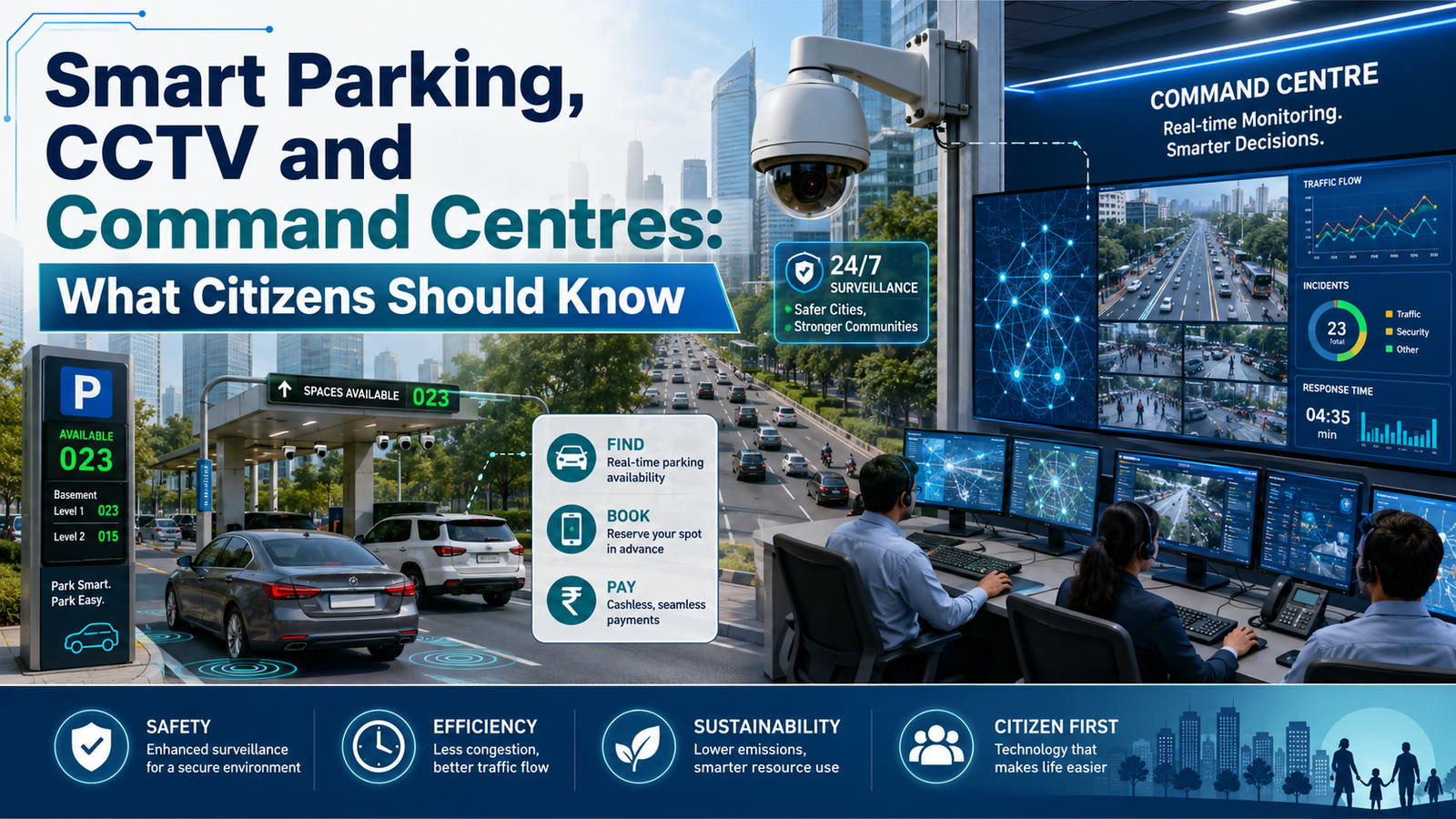

India’s Smart Cities are no longer defined only by flyovers, metro corridors, and modern buildings. A transformation is taking place through smart parking systems, AI-powered CCTV cameras, and Integrated Command and Control Centres that monitor urban life in real time. These technologies are helping cities manage traffic, improve safety, respond faster to emergencies, and deliver more efficient civic services.
If you live in any of India’s 100 Smart Cities — or even a tier-2 town rapidly upgrading its infrastructure — chances are you have already encountered the quiet digital revolution reshaping the streets around you. Smart parking sensors embedded in the tarmac. CCTV cameras that do far more than record footage.
And behind it all, a nerve centre watching over the city in real time.
This is the world of Integrated Command and Control Centres, and every urban citizen deserves to know how it works.
What Is a Smart Parking System?
Smart parking uses IoT sensors, cameras, and automatic number-plate recognition (ANPR) readers embedded in parking bays to determine, in real time, whether a space is occupied. That data is relayed instantly to a control centre and to a smartphone app, guiding drivers directly to available slots.
The result is less circling, less traffic congestion, and less illegal parking.
India’s smart parking market was valued at USD 315.5 million in 2022 and is projected to grow to USD 534 million by 2027, expanding at a compound annual growth rate of 11.11 per cent. Technologies in use span IoT-linked sensors, ultrasonic detectors, RFID tags, and AI-powered cameras capable of reading licence plates in milliseconds.
Also Read: PM-Setu Scheme: Bridging the Skill Gap for India’s Youth!
AI-Powered CCTV: Far More Than a Security Camera
The conventional CCTV camera records what happens — but an AI-enabled camera predicts and responds. Modern smart city surveillance systems in India can perform real-time facial recognition, vehicle identification, crowd density analysis, and intrusion detection.
In Delhi alone, the Safe City Project plans the deployment of 10,000 new AI-enabled cameras, to be integrated with 15,000 existing cameras into centralised command systems.
India’s overall video surveillance market is projected to surge from USD 7.5 billion in 2025 to USD 19.5 billion by 2034. The AI-powered CCTV segment alone is expected to grow from USD 827 million in 2023 to USD 3.66 billion by 2030, reflecting a CAGR of 21.79 per cent.
These are not abstract numbers — they represent millions of cameras watching over roads, metro stations, hospitals, and schools across the country.
The ICCC: India’s Urban Nerve Centre
The ICCC is the center of every smart city. Operating as a centralised hub, an ICCC aggregates data from traffic cameras, surveillance feeds, emergency service call systems, environmental sensors, and public infrastructure monitors. All 100 Smart Cities now have an operational ICCC, as confirmed by the Ministry of Road Transport and Highways.
In cities like Ahmedabad, the ICCC drives the Intelligent Transit Management System and citywide surveillance. In Chandigarh, it manages e-governance services accessed by every citizen. The systems connect police control rooms, fire services, ambulances, civic agencies, and utility companies — all under one roof, all responding in minutes rather than hours.
What Does This Mean for Citizens?
For the ordinary resident, these systems translate into faster emergency response times, better-managed traffic signals, reduced parking stress, and a stronger deterrent against crime. But citizens also carry responsibilities. One should cooperate with civic registration for smart services, respecting CCTV zones, and participating in digital grievance portals connected to the ICCC.
Privacy concerns are legitimate. India does not yet have a comprehensive operational AI surveillance regulation framework, and civil society groups have raised questions about data storage, facial recognition misuse, and consent. Citizens should stay informed, engage with local ward committees, and watch the legislative developments around India’s Digital Personal Data Protection Act.
Also Read: World No Tobacco Day 2026
News4Bharat POV
Smart parking systems are cutting fuel waste and congestion in real time. AI-powered CCTV is doing more than recording — it is detecting threats before they escalate. ICCCs are the operational brains linking every urban service. Citizens benefit most when they engage with these systems — and hold them accountable.
As Indian cities become smarter, citizens must become more digitally aware. Understanding how smart parking, AI CCTV, and ICCCs work is the first step toward using these systems responsibly — and holding them accountable.
FAQs
What is an Integrated Command and Control Centre?
An ICCC is a centralised digital hub that collects and monitors real-time data from city systems such as traffic cameras, emergency services, and more.
How does smart parking work in Indian cities?
Smart parking uses IoT sensors, cameras, RFID systems, and automatic number-plate recognition technology to detect available parking spaces in real time.
What is the role of AI-powered CCTV in Smart Cities?
AI-powered CCTV cameras can analyse live video feeds to detect suspicious activity, recognise vehicles, monitor crowd density, identify traffic violations, and more,
How do ICCCs help citizens?
ICCCs help citizens by enabling faster emergency response, better traffic management, improved public safety, quicker grievance redressal, and more coordinated delivery of civic services.